
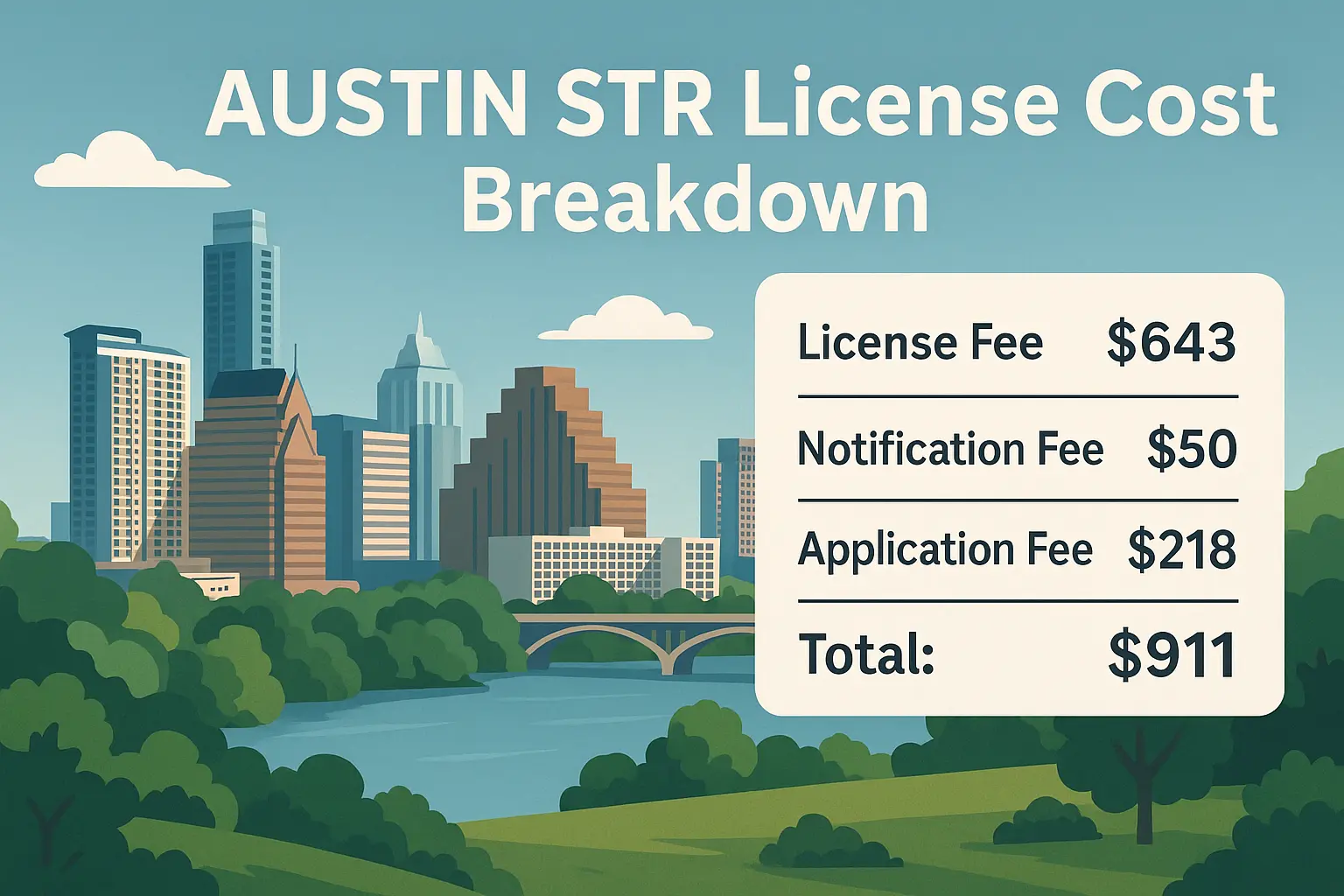
📈 Cost Overview (Updated October 2025)
| Category | Estimated Range |
|---|---|
| One-Time Startup Costs | $986 – $2,636 |
| Biennial Recurring Costs (2-year period) | $1,585 – $4,770+ |
| Hidden / Misc. Costs | $300 – $1,000+ |
| Typical First Two Years Total | $2,871 – $8,406 |
Introduction
Most new hosts assume that getting a Short-Term Rental (STR) license in Austin is as simple as paying the $836.30 fee and waiting for approval. Unfortunately, that’s just the start. Between inspections, safety equipment, and compliance costs, the true investment for the 2-year license period can easily stretch several thousand dollars.
This guide gives you a complete cost breakdown – including the hidden and recurring expenses that most hosts overlook – so you can prepare a realistic budget before listing your property. All information has been updated to reflect the September 2025 ordinance changes that took effect October 1, 2025.
One-Time Startup Costs
Initial Investment Snapshot (Updated October 2025)
| Expense | Estimated Cost |
|---|---|
| License Application Fee (All Types) | $836.30 ($789 license + $47.30 notification) |
| Property Inspection | $0 – $300 (fire safety inspection) |
| Fire Safety Equipment | $150 – $500 (smoke/CO detectors, fire extinguisher) |
| Legal or Consulting Assistance | $0 – $1,000 (optional) |
| Total Startup Range | $986 – $2,636 |
The biggest one-time cost is the $836.30 application fee itself, which is now the same for all license types (Type 1, Type 2, and Type 3). The October 2025 regulation changes eliminated the higher fees previously charged for Type 2 properties. Fire safety inspection and equipment remain mandatory requirements.
Recurring Costs (Per 2-Year License Period)
- 11% – City of Austin (9% occupancy tax + 2% venue project tax)
- 6% – State of Texas
| Recurring Item | Per Year | Per 2-Year License Period |
|---|---|---|
| Hotel Occupancy Tax | 17% of revenue | 17% of revenue (ongoing) |
| License Renewal Fee | — | $385.30 (every 2 years) |
| STR Insurance Premium | $500 – $2,000 | $1,000 – $4,000 |
| Property Management Software | $240 – $1,200 | $480 – $2,400 |
| Periodic Safety Equipment Updates | $0 – $100 | $0 – $200 |
| Total (excluding HOT) | $740 – $3,300/year | $1,865 – $7,385 per 2-year period |
ROI Timeline (Updated for 2025 Regulations)
Based on average nightly rates in Austin and 60–70% occupancy, most hosts recover startup costs after 5–12 bookings. The higher license fee ($836.30 vs. old $418) means it takes slightly longer to break even, but the 2-year validity provides better long-term value.
• Nightly rate: $250
• Occupancy: 70%
• Monthly gross: ~$5,250
• Monthly HOT (17%): -$893
• Monthly net (before expenses): ~$4,357
• Startup investment: $1,500 (license + equipment)
• Break-even: ~5 months of operation
Cost-Saving Strategies
- DIY your application if you understand zoning and inspection rules.
- Buy fire safety equipment in bulk or bundle sets online.
- Handle guest messaging directly to avoid management fees.
- Track deductible expenses for year-end tax relief.
Conclusion: Setting a Realistic Budget (October 2025)
Your total first two-year STR investment in Austin (license period) typically ranges between $2,871 – $8,406. Key changes effective October 2025:
- $836.30 license fee (same for all types, valid 2 years)
- 17% Hotel Occupancy Tax (not 15%)
- No Certificate of Occupancy required
- No insurance proof required for applications
- $385.30 renewal every 2 years
Treat these not as mere costs, but as long-term investments in compliance, guest safety, and sustainable returns.
Cost Comparison: Austin vs. Nearby Texas Cities
| City | STR License Fee | Hotel Tax Rate | Typical Startup Cost | Renewal Frequency |
|---|---|---|---|---|
| Austin | $418 (Type 1) / $918 (Type 2) | 15 % | $2,500 – $8,000 | Biennial |
| Round Rock | $350 (flat) | 13 % | $2,000 – $6,000 | Annual |
| Georgetown | $300 (flat) | 13 % | $1,800 – $5,500 | Annual |
| Waco | $250 (Type 1) / $400 (Type 2) | 13 % | $1,900 – $5,800 | Annual |
| New Braunfels | $275 (flat) | 14 % | $2,100 – $6,000 | Annual |
| Fredericksburg | $200 – $300 (depends on zoning) | 13 % | $2,000 – $6,500 | Biennial |
Case Studies: Real Austin STR Cost Scenarios
Case Study 1 – Owner-Occupied East Austin Suite
A homeowner added a detached guest unit under a Type 1 license. Startup: $1,450 (license + safety gear). Annual: ≈ $1,000. Break-even in 6 bookings; main cost driver was insurance premium adjustment.
Case Study 2 – Downtown Type 2 Loft
Investor-owned condo licensed as Type 2 and listed on Airbnb + Vrbo. Startup ≈ $3,800 (license, legal, furnishings). Monthly costs ≈ $180. ROI after 2 months at 80% occupancy.
Case Study 3 – North Austin Family Conversion
Retiree converted spare rooms under Type 1 license. Setup $1,900 (smoke detectors, furniture). Self-managed with Hospitable ($25/mo). Maintains 65% occupancy → ROI in 5 months.
Case Study 4 – Suburban Type 2 with HOA
Two-story home in HOA community. Compliance review cost $300. Total setup $2,900. Neighbor complaint caused renewal delay → shows value of clear approvals.
Case Study 5 – Small Portfolio Operator
Local manager running three Type 2 units on Airbnb and Vrbo. Startup $8,700; annual recurring ≈ $4,200. Professional cleaning and automation reduced turnover time by 35%. ROI within first quarter.
Common Mistakes Austin STR Hosts Make
Ignoring Hotel Occupancy Tax (HOT) — Airbnb may collect it, but hosts must still report totals to the City and State for compliance.
Skipping inspection prep — Missing smoke or CO detectors, outdated fire extinguishers, and unclear exit routes are the top causes of rejection.
Using residential insurance — Standard homeowner policies rarely cover STR operations; always upgrade to STR or landlord coverage.
Forgetting HOA approvals — Type 2 operators often face fines when renting without explicit HOA consent or zoning confirmation.
Underestimating maintenance costs — Enhanced cleaning, linens, and restocking supplies quickly add up; budget at least $75 per turnover.
Avoid Common STR Mistakes — Quick Checker
Tick every item you’ve completed. Unchecked boxes highlight areas needing attention.
🤔 People Also Ask
How much does it cost to get an Austin STR license in 2025?
As of October 2025, all Austin STR licenses cost $836.30 ($789 license fee + $47.30 notification fee), regardless of type. The license is valid for 2 years. Including inspections and safety equipment, total startup costs average $986 – $2,636. Over the 2-year license period, expect total costs of $2,871 – $8,406.
Is there still a price difference between Type 1 and Type 2 licenses?
No, not anymore. As of October 2025, all Austin STR license types (Type 1, Type 2, and Type 3) cost the same: $836.30 for new applications and $385.30 for renewals. The previous pricing structure that charged more for Type 2 licenses has been eliminated.
Are STR license fees tax-deductible?
Yes — license fees, insurance, and compliance expenses are deductible business costs for rental operators. Confirm details with a licensed tax advisor.
How long to recover my startup costs?
Most hosts reach break-even after 3 – 8 bookings depending on nightly rate, occupancy, and expenses. Prime Austin areas can recover within two months.
Do I need a property inspection?
Yes. Austin requires a fire-safety inspection confirming smoke/CO detectors, extinguishers, and clear exits. Typical cost $0 – $300.
What taxes apply to STRs in Austin?
All STRs pay a 17 % Hotel Occupancy Tax (NOT 15 %) – 11 % City of Austin (9 % occupancy + 2 % venue project tax) and 6 % State of Texas. As of April 2025, platforms like Airbnb and Vrbo automatically collect and remit this tax, but hosts must still file quarterly reports with the City.
Do I need special insurance?
Standard homeowner coverage excludes STR activity. Get a short-term rental or landlord policy covering guest liability and property damage — usually $500 – $2,000 per year.
What if I rent without a license?
Unlicensed STRs face fines of $500 – $2,000 per day and possible legal action. Austin enforces violations through inspections and platform audits.
Can I self-manage my STR?
Absolutely. Many hosts automate messaging, pricing, and cleaning coordination using tools like Hospitable or Guesty, saving up to $1 k per year.
Where can I read official STR requirements?
The official source is the City of Austin STR Licensing Page .
How We Researched This Guide
This guide uses verified, public information from official and platform-provided sources. Our goal is to help STR hosts understand realistic startup and recurring costs using only transparent, verifiable data.
Primary References
- City of Austin — Short-Term Rental Licensing
- Texas Comptroller — Hotel Occupancy Tax (HOT)
- Airbnb Help Center — Host Fees and Service Charges
- Vrbo Help Center — Owner Fees and Commissions
Fee percentages, management costs, and insurance adjustments in this article are drawn directly from Airbnb and Vrbo official documentation as of late 2025.
Published by City Compliance Guide, an independent educational resource focused on Austin STR licensing and compliance.